
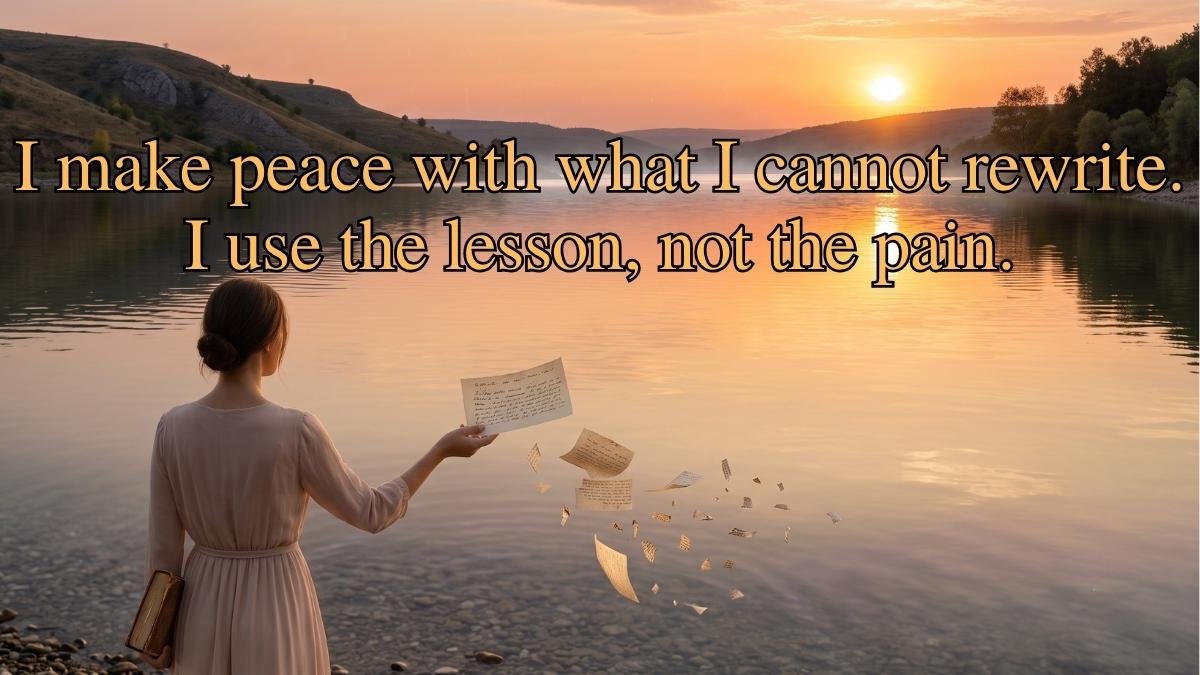
Is there something in your past you wish you could go back and change? A word you wish you hadn’t said, a chance you wish you had taken, a moment you wish had gone differently? Most people carry something like this. Here is a gentle truth worth holding onto:
I make peace with what I cannot rewrite. I use the lesson, not the pain.
This doesn’t mean the past didn’t matter, or that it didn’t hurt. It means choosing to carry forward what it taught you, instead of carrying the weight of wishing it had been different. Let’s understand this in a simple way — so simple that even a child could read it and feel a little lighter afterward.
What This Quote Really Means
Imagine drawing a picture, and halfway through, you accidentally smudge it. You can’t erase the smudge completely — it’s part of the page now. You have two choices: stay upset about the smudge forever, or find a way to turn it into something new, like adding a little cloud or a shadow around it.
Our past works the same way. Some moments can’t be erased or redone, no matter how much we wish they could be. But we still get to choose what we do with what’s left on the page. Making peace means accepting the smudge is there. Using the lesson means finding what it can still teach you, instead of only mourning what it ruined.
This is not about pretending the pain didn’t happen. It’s about slowly separating the lesson from the pain, so you can keep one and gently set down the other.
This separation takes time, and that’s completely alright. Some days you might manage to hold onto the lesson easily. Other days, the old pain might resurface, and that doesn’t mean you’ve failed at making peace — it simply means healing rarely moves in a perfectly straight line.
Ancient Wisdom on Making Peace With the Past
This idea isn’t new. The Bhagavad Gita and the Holy Bible both speak beautifully about releasing what cannot be changed, while holding onto the wisdom it leaves behind. Here are three teachings, paired together.
Quote 1 — The Wise Do Not Grieve the Unchangeable
Bhagavad Gita, Chapter 2, Verse 11: “While speaking learned words, you grieve for what is not worthy of grief. Those who are truly wise do not mourn over what cannot be changed.”
Simple Meaning: This verse gently points out that grief has its place, but endless mourning over something already finished doesn’t bring it back. Making peace begins with accepting that some things are simply done, and grieving them forever won’t rewrite them.
Equivalent Bible Quote — Philippians 3:13-14: “Forgetting those things which are behind, and reaching forth unto those things which are before, I press toward the mark.”
Simple Meaning: Both teachings encourage the same gentle release — looking forward instead of endlessly replaying what’s already behind you. Making peace often means choosing to press forward, even while still carrying the memory.
Quote 2 — Untouched Like a Lotus Leaf
Bhagavad Gita, Chapter 5, Verse 10: “One who acts without selfish attachment, offering the results to the Divine, remains untouched by the outcome — like a lotus leaf that stays dry even while resting on water.”
Simple Meaning: A lotus leaf sits directly on water all day, yet water never soaks into it. This verse teaches that we can be present in difficult experiences without letting their pain permanently soak into who we are. We take the lesson; we let the pain slide off.
Equivalent Bible Quote — Isaiah 43:18-19: “Remember ye not the former things, neither consider the things of old. Behold, I will do a new thing.”
Simple Meaning: Both scriptures gently encourage us not to stay soaked in old pain. Something new is always possible, but it usually requires first setting down what we’ve been holding onto from before.
Quote 3 — Crossing the Ocean of Difficulty
Bhagavad Gita, Chapter 4, Verse 36: “Even if one is considered the most difficult among difficult situations, the boat of true understanding can carry them safely across the ocean of hardship.”
Simple Meaning: No matter how painful a past experience feels, understanding what it taught us can become the very boat that carries us across it. The lesson doesn’t erase the ocean, but it does help us reach the other side.
Equivalent Bible Quote — Romans 5:3-4: “We glory in tribulations also: knowing that tribulation worketh patience; and patience, experience; and experience, hope.”
Simple Meaning: Both teachings describe the same quiet transformation — hardship, when understood rightly, slowly turns into patience, wisdom, and eventually hope. This is exactly what it means to use the lesson, not the pain.
A Short Story About Making Peace
Sameer had said something hurtful to a close friend years ago, during an argument he deeply regretted. The friendship never fully recovered, and for a long time, Sameer replayed that one conversation over and over, wishing he could go back and choose different words.
Eventually, a mentor asked him gently, “What did that moment teach you?” Sameer realized it had taught him how quickly careless words can damage something valuable, and how important it was to pause before speaking in anger. He couldn’t rewrite that old conversation. But he could carry its lesson into every relationship afterward, becoming someone far more careful and gentle with his words. The pain slowly faded. The lesson stayed, and it made him better.
When This Quote Proves Most Helpful
This quote brings comfort in moments like these:
- When you keep replaying a past mistake and wishing you could undo it.
- When a relationship ended in a way you didn’t get to choose or control.
- When you’re carrying guilt over something that already happened and cannot be changed.
- When you’re grieving a loss and searching for meaning within the pain. (If grief is part of your journey right now, our guide on gently processing loss may help alongside this article.)
- When you’re stuck comparing your present to a different past you wish you’d had.
- When you’re ready to stop punishing yourself and start learning from what happened instead.
In each of these moments, choosing to make peace with what cannot be rewritten — and gently keeping the lesson instead of the pain — can turn a heavy memory into quiet, hard-won wisdom.
Three Psychosomatic Exercises For Making Peace
“Psychosomatic” simply means connecting mind and body together. These three simple exercises use breath, touch, and gentle movement to help your body release old pain while keeping the wisdom it left behind. No equipment needed — a child can try these too.
Exercise 1: The Rewrite Release Breath. Sit comfortably and breathe in slowly for 4 seconds, silently thinking of the past moment you wish you could change. Hold for 2 seconds. Breathe out slowly for 6 seconds, silently thinking, “I make peace with what I cannot rewrite.” Repeat 5 times. This helps your nervous system practice letting go, one gentle breath at a time.
Exercise 2: The Keep and Release Tap. Gently tap two fingers to your temple, silently saying, “I keep the lesson.” Then shake both hands out at your sides, as if shaking off water, silently saying, “I release the pain.” Repeat 3 times. This small physical separation helps your body practice holding onto wisdom while letting the emotional weight fall away.
Exercise 3: The Closed Hand Opening. Make a tight fist with one hand, imagining it holding the old pain. Hold it for 5 seconds, then slowly open your fingers, turning your palm upward and open. As you do, imagine only the lesson remaining gently in your open palm, light and simple. This physical release trains your body to let go of tightly-held pain, little by little.
Learn more about building positive habits in our recent internal guide.
A Gentle Closing Thought
Some pages of your story cannot be rewritten, no matter how much you wish they could be. But you still get to decide what you carry forward from them.
I make peace with what I cannot rewrite. I use the lesson, not the pain. Slowly, gently, that quiet choice can turn even your hardest chapters into the wisdom that carries you forward.