
Do you ever feel like you can’t relax until you’ve figured everything out? Until the plan is clear, the worry is solved, the next step is certain? It’s exhausting to carry that weight. But here is a gentle truth worth remembering:
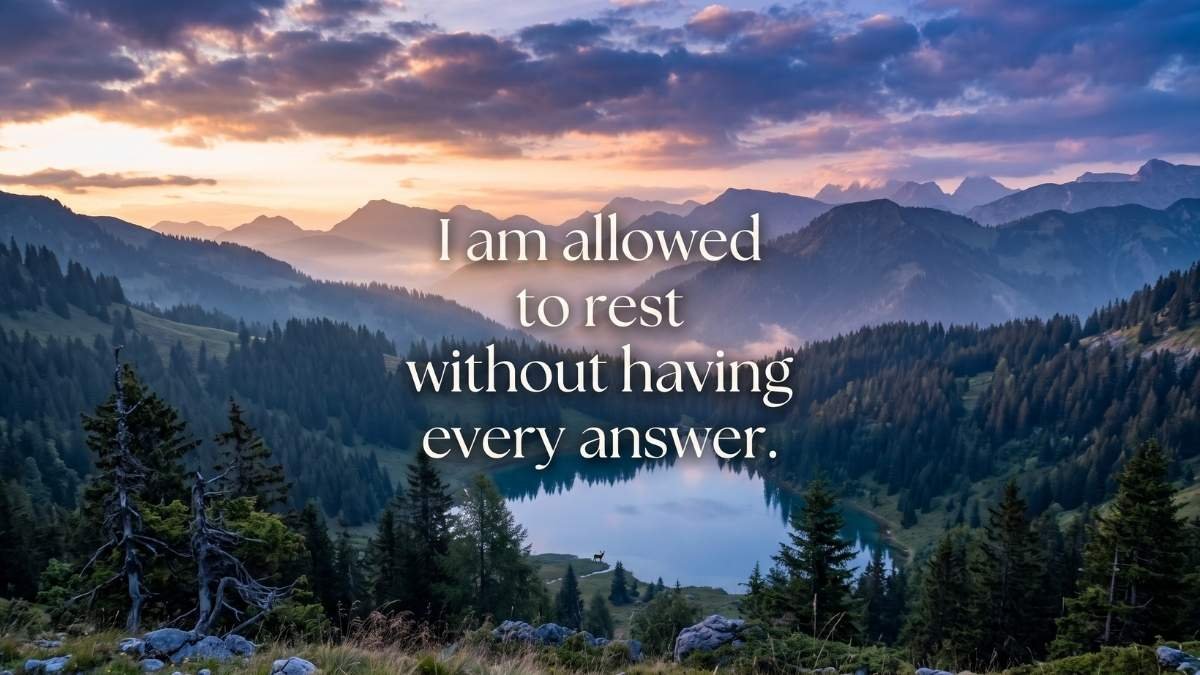
I am allowed to rest without having every answer.
Rest was never meant to be a reward you earn only after solving everything. Sometimes, rest is exactly what helps the answers arrive more clearly, later. Let’s understand this in a simple way — so simple that even a child could read it and feel a little lighter afterward.
What This Quote Really Means
Imagine trying to solve a difficult puzzle late at night, feeling more tired and frustrated with every piece. Sometimes, the wisest thing to do isn’t to keep pushing through exhaustion — it’s to simply stop, rest, and return to the puzzle in the morning with fresh eyes. The puzzle isn’t abandoned. It’s just paused, gently, until you’re ready again.
Life often works the same way. Not every question needs solving right now. Not every worry needs an immediate answer. You are allowed to rest in the middle of uncertainty, the same way you’d rest in the middle of a long journey, without feeling guilty for pausing.
This doesn’t mean giving up on finding answers eventually. It simply means understanding that rest and uncertainty can exist together, without one canceling out the other. You can be tired, unsure, and still worthy of a peaceful pause.
Many of us were taught, without realizing it, that rest must be earned — that we can relax only after every task is finished and every problem solved. But real life rarely offers that clean finish line. There is almost always something unresolved. If rest waits for a perfectly sorted life, it may never come at all.
Ancient Wisdom on Being Allowed to Rest
This idea isn’t new. The Bhagavad Gita and the Holy Bible both speak beautifully about the importance of rest, and about trusting something larger than our own limited understanding. Here are three teachings, paired together.
Quote 1 — Rest Is Part of a Balanced Life
Bhagavad Gita, Chapter 6, Verses 16-17: “One cannot walk a steady spiritual path by eating too much or too little, sleeping too much or too little. One who is balanced in eating, resting, work, and recreation finds the path that eases all suffering.”
Simple Meaning: This verse teaches that rest isn’t a distraction from a meaningful life — it’s actually part of it. Trying to push through everything without pause often creates more suffering, not less. You are allowed to rest simply because balance requires it.
Equivalent Bible Quote — Mark 6:31: “Come ye yourselves apart into a desert place, and rest a while.”
Simple Meaning: Even in the Bible, rest is gently commanded, not just permitted. Both teachings agree — stepping away to rest isn’t laziness. It’s wisdom, and sometimes even necessity.
Quote 2 — Peace Doesn’t Require Having It All Figured Out
Bhagavad Gita, Chapter 12, Verse 12: “Better than mere knowledge is meditation, and better than meditation is releasing attachment to outcomes, for such release brings true peace of mind.”
Simple Meaning: Peace doesn’t come from knowing every answer. It often comes from gently letting go of the need to control every outcome. You are allowed to rest, even while some questions remain unanswered.
Equivalent Bible Quote — Matthew 11:28: “Come unto me, all ye that labour and are heavy laden, and I will give you rest.”
Simple Meaning: This verse offers rest directly to those who are tired and burdened, with no requirement of having solved anything first. Both teachings offer the same comfort — rest is available to you exactly as you are, uncertainty and all.
Quote 3 — You Don’t Have to Know It All Alone
Bhagavad Gita, Chapter 4, Verse 34: “Seek understanding through humble inquiry and sincere service. Those who have already seen the truth can help guide you toward it.”
Simple Meaning: This verse gently reminds us that we’re not meant to carry every answer alone. Wisdom often arrives through others, through patience, and through time — not through struggling in isolation.
Equivalent Bible Quote — Isaiah 55:8-9: “For my thoughts are not your thoughts, neither are your ways my ways… so are my ways higher than your ways, and my thoughts than your thoughts.”
Simple Meaning: Both scriptures remind us that a wisdom greater than our own is often at work, especially in situations we can’t fully understand yet. You are allowed to rest, trusting that not every answer needs to come from you alone, right now.
A Short Story About Being Allowed to Rest
Vikram had been awake for three nights in a row, trying to decide whether to accept a job offer in a new city. He made lists, called friends, and replayed every possible outcome in his mind, hoping certainty would finally arrive if he just thought hard enough.
Exhausted, he finally told himself, “I don’t have to decide tonight. I’m allowed to rest first.” He slept properly for the first time in days. The next morning, with a clearer, calmer mind, the right decision suddenly felt obvious — something his tired, anxious brain hadn’t been able to see the night before. Rest hadn’t delayed his answer. It had helped it arrive.
When This Quote Proves Most Helpful
This quote brings comfort in moments like these:
- When you’re facing a big decision and feel pressured to figure it out immediately.
- When uncertainty about the future is keeping you from sleeping or relaxing.
- When you feel guilty for taking a break while problems remain unsolved.
- When you’re overwhelmed by too many unanswered questions at once.
- When you’re recovering from burnout and need permission to simply stop for a while. (If exhaustion has been building for a while, our guide on gently recovering from burnout may help alongside this article.)
- When you catch yourself believing that rest must be earned only after everything is resolved.
- When you’re supporting a tired friend or family member and want gentle words to offer them.
In each of these moments, remembering that you are allowed to rest — even without every answer — can turn exhausting pressure into gentle permission to simply pause.
Three Psychosomatic Exercises For Being Allowed to Rest
“Psychosomatic” simply means connecting mind and body together. These three simple exercises use breath, movement, and gentle pausing to help your body and mind feel permission to rest, even without every answer. No equipment needed — a child can try these too.
Exercise 1: The Permission Breath. Sit or lie down comfortably. Breathe in slowly for 4 seconds, silently thinking, “I don’t need every answer right now.” Hold for 2 seconds. Breathe out for 6 seconds, silently thinking, “I am allowed to rest.” Repeat 5 times. This helps your nervous system settle, easing the pressure of needing instant answers.
Exercise 2: The Heavy Bag Set Down. Stand up and imagine holding a heavy bag filled with all your unanswered questions. Take one deep breath in, and as you exhale, mime gently setting that bag down onto the floor beside you. Let your shoulders drop and relax. This small physical gesture helps your body release the tension of carrying uncertainty everywhere you go.
Exercise 3: The Soft Eyelid Rest. Sit comfortably and gently close your eyes. Let your eyelids feel heavy and relaxed, without straining to think or solve anything. Stay like this for one full minute, breathing slowly and naturally. This simple pause allows your mind a small, guilt-free rest, even in the middle of an unresolved day.
Learn more about building positive habits in our recent internal guide.
A Gentle Closing Thought
You don’t need every answer figured out before you’re allowed to breathe easily again. Rest was never meant to wait at the very end of your uncertainty — it can gently exist right in the middle of it.
I am allowed to rest without having every answer. And so are you. The questions will still be there tomorrow, but so will your strength to face them, a little more rested than today.