
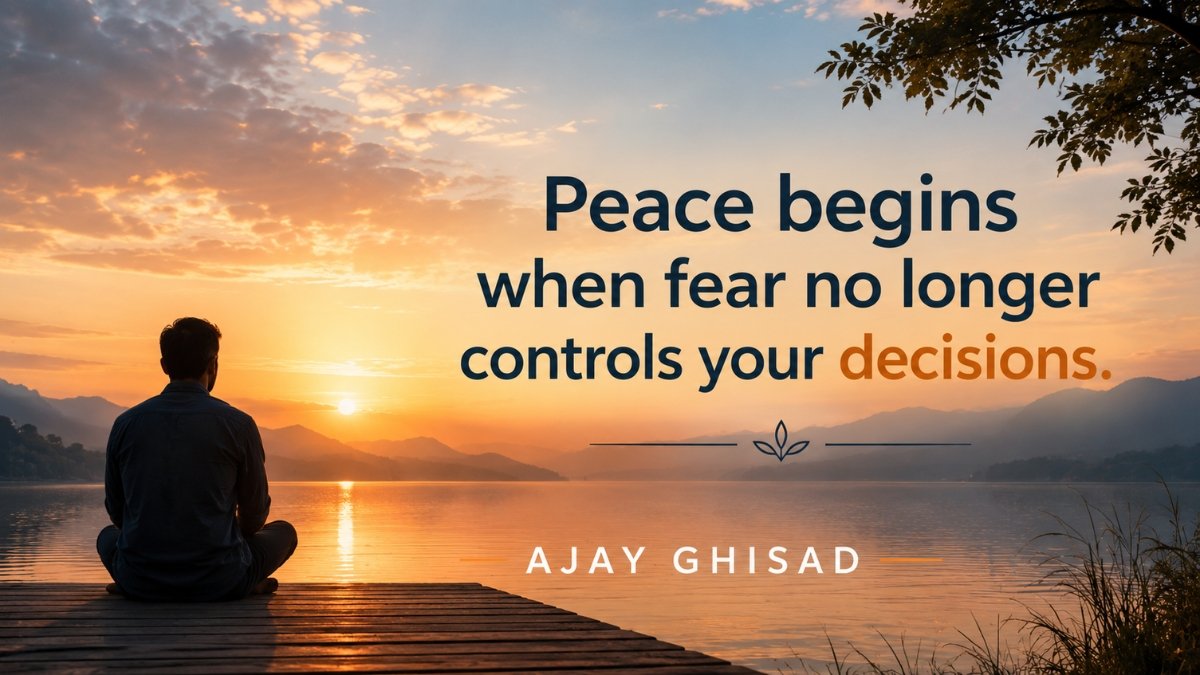
We make thousands of choices every single day. From the minor details of what we eat to major shifts like changing careers, moving across the world, or walking away from a toxic situation. But if you strip away the surface-level logic of your biggest choices, a critical question remains: Are your decisions driven by inspiration, or are they driven by fear?
There is an ancient, universal truth woven through the fabric of all human wisdom: Peace begins the exact moment fear no longer controls your decisions.
When fear holds the steering wheel, your life shrinks. You accept less than you deserve, stay in situations that drain your soul, and play small to avoid discomfort. But when you step outside the shadow of fear, you unlock a deep, unshakeable inner peace.
This guide breaks down how to recognize fear-based choices, synthesizes the universal spiritual wisdom that helps us overcome them, and provides an actionable blueprint to reclaim your decision-making power.
The Hidden Cost of Fear-Based Decision Making
Fear is a master of disguise. It rarely shows up saying, “I am keeping you small because I am terrified.” Instead, it masquerades as logic, practical thinking, timing, or responsibility.
You don’t stay in a miserable job because you are scared of failing at a new one; you tell yourself you are just being “financially responsible.”
You don’t avoid setting boundaries because you fear conflict; you tell yourself you are just being “peaceful and accommodating.”
When you constantly make choices to avoid what you dread rather than to build what you love, you live in a state of survival. Survival mode and inner peace cannot coexist.
Fear-Driven vs. Peace-Driven Choices
To understand where you stand, look at how these two opposing forces shape your daily life:
| Aspect | Fear-Driven Decisions | Peace-Driven Decisions |
| Core Motivation | Avoiding pain, loss, rejection, or failure. | Aligning with growth, truth, and purpose. |
| Physical Feeling | Tightness in the chest, anxiety, urgency, fatigue. | Expansion, clarity, calm certainty, alignment. |
| Focus Area | What could go wrong (the worst-case scenario). | What is right, true, and constructive right now. |
| Long-Term Result | Regret, stagnation, resentment, and chronic stress. | Internal growth, freedom, and genuine fulfillment. |
The Universal Spiritual Truth: The Collective Wisdom of Humanity
Every great spiritual philosophy across human history points to a single, unified reality: Fear is an illusion of the mind, and your true nature is peace.
When we look at the core spiritual heritage of humanity—removing the names of specific factions, historical labels, or cultural divisions—we find a beautifully synchronized message about how to conquer fear.
1. The Principle of the Eternal Witness
Universal wisdom teaches that you are not your thoughts, nor are you your fears. You are the conscious awareness observing those thoughts. When fear arises, it is simply a passing storm in the vast sky of your awareness. The sky does not change because of a storm; it simply allows it to pass. Peace begins when you stop identifying with the storm and remember that you are the sky.
2. The Illusion of Separation and Control
We experience fear because we think we are completely isolated individuals fighting against a hostile universe. Universal spirituality reminds us that we are intimately connected to the source of all life. Fear whispers that you must control every outcome to be safe. True wisdom whispers that control is a myth, and safety comes from trusting the divine intelligence that keeps the planets in orbit and breathes life into your body.
3. The Power of Surrender
Surrender is often misunderstood as giving up, but it is actually the ultimate act of courage. It means letting go of your attachment to how things must look. When you surrender your fear of the future, you stop forcing situations. You make decisions based on what is right in the present moment, trusting that the ultimate outcome will serve your highest growth.
“True freedom is having nothing to lose, nothing to protect, and nothing to prove. When you protect nothing, fear vanishes.” — Universal Wisdom
The 4 Steps to Reclaim Your Decisions from Fear
Shifting away from fear-based living is not a one-time event; it is a daily, intentional practice. Use this step-by-step framework to transition from anxiety to aligned action.
Step 1: Interrupt the Urgency (The Power of the Pause)
Fear thrives on artificial urgency. It screams that you must act immediately, reply right now, or make a panicked move to protect yourself. Whenever you feel a sudden, chaotic rush to make a decision, pause. Take three deep breaths. Force your nervous system out of a fight-or-flight response before you speak or act.
Step 2: Name the Fear Explicitly
Bring the hidden fear into the light. Ask yourself directly: “What am I actually afraid of happening here?”
Are you afraid of being broke?
Are you afraid of being lonely?
Are you afraid of looking foolish to others?
Shining a light on a fear robs it of its power. A fear named is a problem you can solve; a fear hidden is a ghost that runs your life.
Step 3: Shift the Question from “What if” to “What is”
Fear lives exclusively in a future that hasn’t happened yet, running infinite loops of “What if everything falls apart?” Shift your focus back to the present moment by asking: “What is the truest, most constructive action I can take right now?” This anchors your mind back into reality, where peace resides.
Step 4: Accept the Worst-Case Scenario, Then Move Past It
Most of the time, our minds build up the worst-case scenario into a catastrophic event we could never survive. Realistically look at that worst-case outcome. If you take the leap and fail, what happens? You rebuild. You learn. You adapt. Once you realize you can survive the worst-case scenario, the fear loses its grip over your choices.
How Overcoming Fear Transforms the Key Areas of Your Life
[Fear-Based Living]  ---> Shrinks Options, Causes Anxiety, Creates Stagnation
[Peace-Based Living] ---> Expands Potential, Elevates Clarity, Creates True Freedom
When you consciously decide to stop letting fear call the shots, every single area of your life undergoes a massive upgrade.
1. Career and Abundance
When fear drives your career, you stay in unfulfilling roles because of a scarcity mindset—the belief that there will never be enough opportunities, money, or security elsewhere. When peace drives your career, you recognize your intrinsic value. You make career moves based on growth, alignment, and contribution. Paradoxically, letting go of the desperate fear of losing money often opens the door to genuine abundance.
2. Relationships
Fear-based relationships are anchored in the dread of rejection or loneliness. This causes people to tolerate disrespect, ignore glaring red flags, or morph into people-pleasers. A peace-based relationship is built on mutual respect and wholeness. You don’t choose a partner to fill an empty, terrified void inside you; you choose them to share in the fullness of life you’ve already cultivated.
3. Personal Growth and Self-Expression
When you fear the judgment of the crowd, you camouflage yourself. You mute your unique voice, hide your creativity, and conform to societal expectations. Dropping that fear allows you to live authentically. You accept that you will not be everyone’s cup of tea, and you find immense peace in being exactly who you were created to be.
A Daily Practice for Centering in Peace
To firmly anchor this mindset, practice this brief reflection every morning before checking your phone or engaging with the world:
Sit in silence for two minutes. Connect with the quiet space inside your chest.
Affirm your safety: Tell yourself, “I am safe in this present moment. I trust the flow of life.”
Set your intention: “Today, I choose love over fear. I choose truth over comfort. My decisions will come from my peace, not my anxiety.”
The Ultimate Destination: Absolute Inner Freedom
Living a life where fear no longer controls your decisions does not mean you will never experience the emotion of fear again. Fear is a natural biological reflex. The difference is that fear will become an informational data point rather than the decision-maker.
You will see the fear, acknowledge its attempt to keep you safe in a small comfort zone, thank it for its input, and then make your choice based on peace, truth, and growth anyway.
When you strip fear of its vote in your life’s direction, the background noise of anxiety fades away. What remains is a profound, unshakeable serenity—the realization that no matter what happens in the outside world, the sanctuary of peace within you can never be destroyed.