
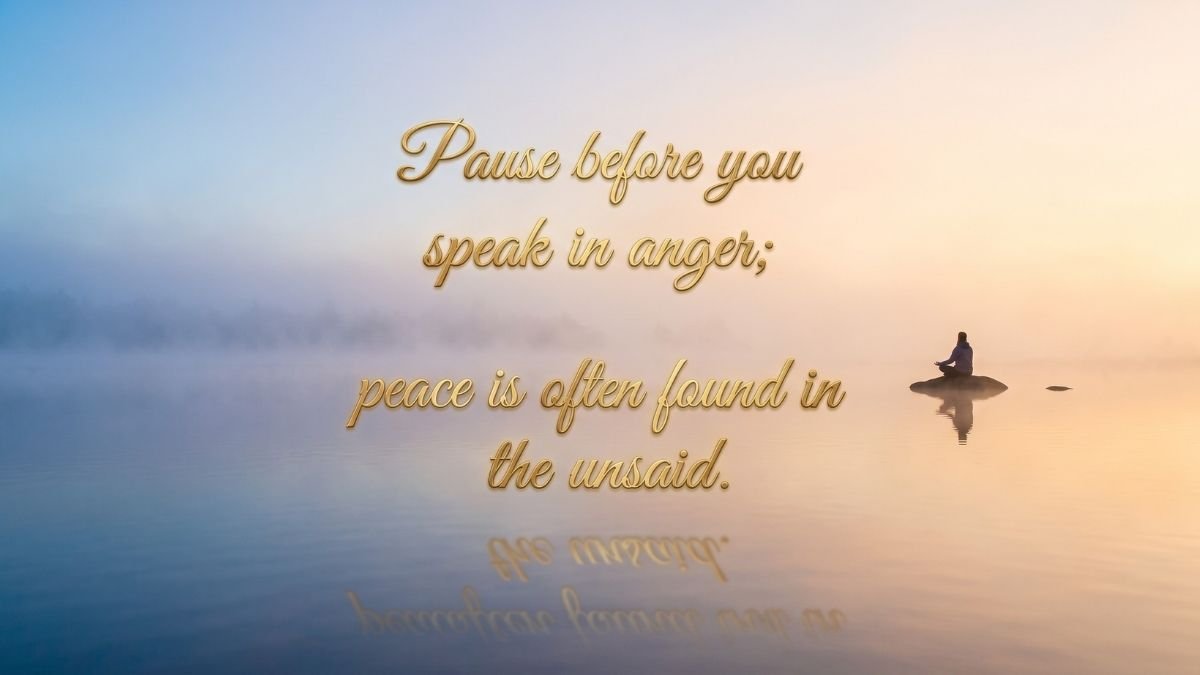
Have you ever said something in the heat of the moment and immediately wished you could take it back? A sharp word spoken in anger can undo months of trust, damage a friendship, or leave a wound that takes a very long time to heal. Here is a gentle truth worth remembering:
Pause before you speak in anger; peace is often found in the unsaid.
The words we choose not to say in an angry moment can protect more than the words we choose to say. This doesn’t mean staying silent forever or avoiding honest conversations — it simply means creating one small, powerful gap between the feeling and the response. Let’s understand this in a simple way — so simple that even a child could read it and feel a little wiser afterward, wherever in the world they happen to be reading it.
What This Quote Really Means
Imagine you’re holding a glass of water that’s been shaken. If you pour it immediately, everything spills out in a rush — cloudy, unsettled, and impossible to take back. But if you set it down and wait just a moment, the water slowly settles, becomes clear again, and can be poured calmly and carefully.
Anger works very much like that shaken glass. When we’re deeply upset, our thoughts are cloudy, our words are hurried, and our emotional state is unsettled. The pause before you speak in anger is simply the moment you set the glass down, waiting for just enough clarity to respond thoughtfully instead of reactively.
This is not about weakness. It is not about hiding how you feel or pretending everything is fine. It’s about choosing the right moment to speak, and the right words to use, so that what comes out actually helps the situation rather than making it worse. The unsaid word in an angry moment is often the kindest and most powerful choice you can make.
Ancient Wisdom on Pausing Before Speaking in Anger
This idea isn’t new. The Bhagavad Gita and the Holy Bible both speak beautifully about the power of restraint in moments of anger. Here are three teachings, paired together.
Quote 1 — Anger Is the Enemy Within
Bhagavad Gita, Chapter 16, Verse 21: “There are three gates leading to darkness — lust, anger, and greed. Every sane person must give these up, for they lead to the degradation of the soul.”
Simple Meaning: This verse names anger clearly as one of the forces that can pull a person away from their best self. The decision to pause before you speak in anger is, in its own quiet way, a decision to protect your own soul from unnecessary damage.
Equivalent Bible Quote — James 1:19-20: “Let every man be swift to hear, slow to speak, slow to wrath: for the wrath of man worketh not the righteousness of God.”
Simple Meaning: Both teachings offer the same gentle instruction — listen quickly, speak slowly, and let anger settle before responding. A pause before you speak in anger aligns beautifully with this ancient, simple wisdom.
Quote 2 — Self-Control Is True Power
Bhagavad Gita, Chapter 5, Verse 23: “Before giving up the body, one who is able to tolerate the urges of desire and anger is a disciplined person — and that person is truly happy.”
Simple Meaning: This verse describes a person who can pause before acting on anger as genuinely strong — not someone who suppresses every feeling, but someone who chooses their response with intention rather than impulse.
Equivalent Bible Quote — Proverbs 16:32: “He that is slow to anger is better than the mighty; and he that ruleth his spirit than he that taketh a city.”
Simple Meaning: Both scriptures place self-mastery above every external achievement. To pause before you speak in anger is to exercise the highest kind of strength — quiet, steady, and deeply powerful.
Quote 3 — Peace Comes From Inner Steadiness
Bhagavad Gita, Chapter 2, Verse 64: “But a person who has learned to control the senses and who is free from attraction and repulsion, even while meeting the world’s objects, attains a serene, steady peace.”
Simple Meaning: This verse shows us the direct link between self-control and peace. Peace doesn’t arrive from outside — it settles in quietly the moment we learn to pause, regulate, and respond with intention rather than reaction.
Equivalent Bible Quote — Philippians 4:7: “And the peace of God, which passeth all understanding, shall keep your hearts and minds.”
Simple Meaning: Both teachings promise the same reward — a deep, lasting peace that settles into our hearts when we choose steady, thoughtful responses over reactive, anger-driven ones.
A Short Story About Pausing Before Speaking
David and his teenage son had been arguing more frequently over the past year. One evening, after his son said something that cut deeply, David felt the sharp words already forming in his mouth — words that would have won the argument but likely cost him something far more important.
Instead, he paused. He physically turned away for a moment, took three slow breaths, and said quietly, “I need a few minutes before we continue this.” He walked to the garden, sat down, and by the time he returned, both his words and his son’s defenses had softened. The conversation that followed was the most honest and connecting one they had shared in months. David later said it was the most powerful thing he hadn’t said that evening that made everything else possible.
When This Quote Proves Most Helpful
This quote brings guidance in moments like these:
- When a heated argument is escalating and you feel the urge to say something sharp and final.
- When a text, email, or message has triggered a strong emotional reaction and you’re about to reply impulsively.
- When a family member, colleague, or partner has said something that genuinely hurt you. (If anger in a close relationship has become a heavier pattern, our guide on gently rebuilding communication may help alongside this article.)
- When you’re tired, stressed, or overwhelmed and your patience is thinner than usual.
- When a child or younger person is looking to you for how an adult handles strong emotions.
- When you’ve said something in anger before and regretted it deeply, and want to respond differently this time.
In each of these moments, the decision to pause before you speak in anger can protect a relationship, preserve your dignity, and open a door to peace that a hasty word would have slammed shut.
Learn more about building positive habits in our recent internal guide.
Three Psychosomatic Exercises to Pause Before Speaking
“Psychosomatic” simply means connecting mind and body together. These three simple exercises use breath, physical movement, and gentle awareness to help your body create the pause you need before speaking in anger. No equipment needed — a child can try these too.
Exercise 1: The Five-Count Pause Breath. The moment you feel the urge to speak in anger, close your lips gently and breathe in through your nose for 5 slow counts. Hold for 2 counts. Breathe out slowly through your nose for 5 counts. This brief pause gives your nervous system just enough time to shift out of reactive mode, making space for a calmer, clearer response.
Exercise 2: The Jaw and Shoulder Drop. When anger rises, notice how your jaw tightens and your shoulders rise. Deliberately unclench your jaw and let it drop slightly open. Roll your shoulders gently downward and back. Take one slow breath. This physical release sends a signal to your brain that the threat has passed, softening your emotional response before you speak.
Exercise 3: The Step-Back Reset. Physically take one small step backward from the situation — literally one step, if you are standing, or simply lean back slightly if seated. This tiny movement creates a brief physical distance that mirrors the mental pause you need. Pair it with a slow breath and a silent thought: “I choose my next words carefully.” This trains your body to associate stepping back with gaining perspective, not giving up.
External Resources on Pausing Before Speaking in Anger
If you’d like to explore this topic further, these resources are helpful starting points:
- Explore full Bhagavad Gita translations at Holy Bhagavad Gita
- Read more Bible verses on patience and self-control at BibleGateway
- Learn practical anger management techniques from Mayo Clinic’s anger management guide
- Read more about the science of emotional regulation at HelpGuide’s guide to improving emotional intelligence
A Gentle Closing Thought
The next time anger rises in your chest and the sharp words are ready at the tip of your tongue — pause. Just for a moment. One breath, one step back, one quiet count to five.
Peace is often found in the unsaid. Not in the silence of avoidance, but in the wise, gentle space between feeling something strongly and choosing how to respond to it. That pause, practiced again and again, has the power to protect the people you love, and the person you’re becoming.