
Have you ever looked at something and thought, “I can’t do that”? Maybe it was a new job, a big test, a hard talk with someone, or a dream that felt too far away. Almost everyone has felt this way. You are not weak. You are human.
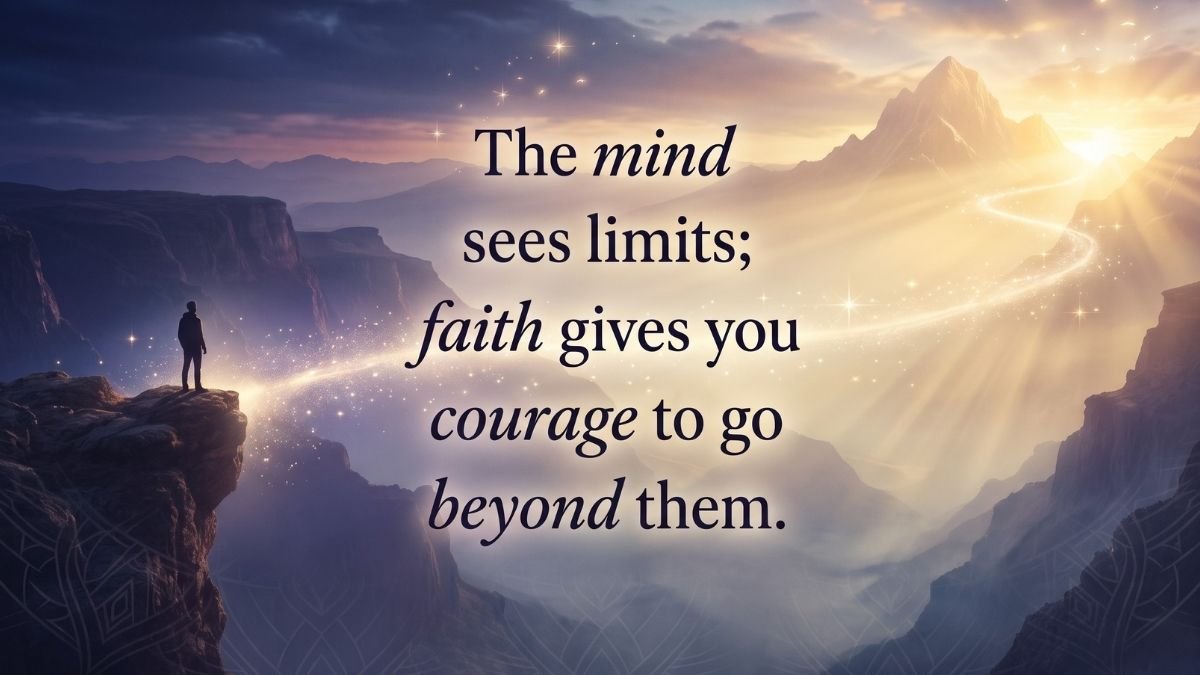
Here is a simple truth worth remembering: “The mind sees limits; faith gives you courage to go beyond them.”
Our mind is like a careful guard. Its job is to keep us safe, so it looks at a big challenge and says, “Stop! That is too hard. Remember what happened last time?” The mind is good at counting problems. But the mind cannot see the future, and that is where faith gives courage to go beyond limits.
Faith is the quiet feeling inside that says, “I may not see the whole road, but I can take the next step.” Whether your faith is in God, in a higher power, or in a good outcome, it works like a lantern. It does not light the whole path. It lights enough for the next step, and then the next one.
In this article, we will learn from two of the most loved books in the world: the Bhagavad Gita and the Holy Bible. We will look at three verses from each, learn what they mean in simple words, and then try three easy exercises that calm your body and mind. A child can understand this, and so can you. Let’s begin with hope.
Why Does the Mind See Limits?
Think about a small kitten. If a kitten falls off a sofa once, it may not jump again for a while. The kitten is not foolish. It is protecting itself.
Our minds work in the same way. They remember every time we failed, felt embarrassed, or got hurt. Then they build invisible walls around us. These walls sound like:
- “I am not good enough.”
- “It is too late for me.”
- “What if I fail?”
- “Other people can do it, but not me.”
These thoughts feel very real, but they are only thoughts. They are not facts. A wall made of thoughts can be crossed, and faith is the ladder.
Faith does not mean you will never feel afraid. Courage is not the absence of fear. Courage is taking a small step while fear is still sitting next to you. When faith walks beside you, fear becomes quieter.
Three Bhagavad Gita Teachings and Their Bible Partners
Both the Gita and the Bible speak to people who feel stuck, scared, or tired. Their words come from different lands and different times, yet they carry a very similar message of hope. Let us read three pairs side by side.
1. Rise Above Weakness of Heart
Bhagavad Gita 2.3: Krishna tells Arjuna not to give in to weakness, because it does not suit him. He urges him to shake off this small weakness of heart and rise up. You can read the verse on the Holy Bhagavad Gita website (BG 2.3).
What it means in simple words: Arjuna was a brave warrior, but one day he froze with fear and sadness and wanted to give up. Krishna did not shout at him to hurt him. He reminded him of who he really was. The message for us is the same: the fear you feel is small compared with the strength inside you. You are bigger than your worry. Stand up gently and begin again.
Matching Bible Verse, Joshua 1:9: “Be strong and courageous. Do not be afraid; do not be discouraged, for the Lord your God will be with you wherever you go.” You can read it on BibleGateway (Joshua 1:9).
How they connect: Both verses speak to someone who feels shaky. Krishna says, “Rise up.” God says, “Be strong, you are not alone.” Notice that the Bible adds a warm promise: God goes with you wherever you go. Courage grows faster when we know we are not walking alone.
2. Faith Is the Key That Opens Hidden Doors
Bhagavad Gita 4.39: Those whose faith is deep, and who practice calming their mind and senses, gain wisdom. Through that wisdom they quickly find lasting peace. Read it on the Holy Bhagavad Gita website (BG 4.39).
What it means in simple words: Some things cannot be understood with the mind alone. You cannot always see why something is happening, or how a problem will end. Faith helps us accept what we cannot yet understand. When we also calm our thoughts, wisdom and peace come, often sooner than we expect. Think of a tired traveler who trusts that a village lies beyond the hills. Because of that trust, he keeps walking until he reaches it.
Matching Bible Verse, 2 Corinthians 5:7: “For we live by faith, not by sight.” You can read it on BibleGateway (2 Corinthians 5:7).
How they connect: The word “sight” in this verse is just like the word “mind” in our quote. Sight and mind only see what is in front of them right now. Faith sees further. When you live by faith, you do not wait for every problem to disappear before you move. You move, and the path appears step by step.
3. No Obstacle Is Final
Bhagavad Gita 18.58: Krishna says that if you keep your mind fixed on him, by his grace you will overcome all obstacles and difficulties. Read it on the Holy Bhagavad Gita website (BG 18.58).
What it means in simple words: Imagine you are climbing a steep hill, and it feels impossible. Now imagine someone strong takes your hand. The hill is still there, but it feels much smaller. This verse teaches that when you stay connected to the Divine in your heart, every obstacle becomes something you can cross. You do not have to be perfect or know everything. You only have to stay close and keep going.
Matching Bible Verse, Matthew 19:26: “With man this is impossible, but with God all things are possible.” You can read it on BibleGateway (Matthew 19:26).
How they connect: Both verses carry the same hopeful promise. What looks “impossible” to the mind is not impossible with faith. The word “impossible” belongs to the mind. The word “possible” belongs to faith. Many people have crossed the very walls they once thought could never be crossed.
When Will This Quote Help You Most?
“The mind sees limits; faith gives you courage to go beyond them” is like a friend you can call in many moments. It can bring real comfort when:
- You are afraid to start something new. A new school, a new city, a new job, or a new business can make the heart race. This quote reminds you that the first step is always the hardest, and it gets easier.
- You have failed before and fear failing again. Past mistakes are lessons, not a final verdict on your life. Faith helps you try one more time.
- A dream feels too big. When people say, “Be realistic,” and your mind agrees, remember that every great journey began with someone who dared to try.
- You are going through a hard season. Illness, money worries, loneliness, or loss can make the future look dark. Faith whispers that the story is not over yet.
- You feel stuck and tired of trying. This quote is a gentle push that says, “There is more road ahead, and you are able to walk it.”
If you are reading this on a heavy day, please know that your feelings are valid, and your story is not finished. If your worries ever feel too heavy to carry, please talk to someone you trust or a qualified professional. Asking for help is also an act of courage.
Three Simple Mind-Body Exercises to Build Courage
Faith lives in the heart, but it also lives in the body. When we are scared, our shoulders rise, our breath becomes short, and our hands clench. The mind and body talk to each other all day. That is why calming the body can help the mind feel braver. These exercises are very easy, take only a few minutes, and are safe for almost everyone. If you feel dizzy or unwell at any point, stop and rest.
Exercise 1: The Doorway Step (Crossing the Limit)
This exercise helps your body feel what it is like to “go beyond a limit.”
- Find a doorway in your home. Stand a little before it.
- Think of one limit your mind keeps repeating, such as “I can’t speak in front of people.” Say it out loud, quietly.
- Take a slow breath in through your nose for four counts.
- As you breathe out slowly, step through the doorway and say, “I can take one step with faith.”
- Stand on the other side and feel your feet on the floor. Repeat three times.
Why it helps: Your brain learns through movement. When your body physically crosses a line while you speak a hopeful sentence, the mind starts to believe that crossing limits is possible.
Exercise 2: The Backpack Release (Letting Go of Heavy Thoughts)
This exercise relaxes the tight muscles that fear creates.
- Sit or stand comfortably. Imagine you are wearing a heavy backpack filled with “I can’t,” “what if,” and “not good enough” stones.
- Squeeze your fists and lift your shoulders up to your ears. Hold for five seconds. Feel the tightness.
- Now let everything go at once. Drop your shoulders, open your hands, and sigh out loud as if you are setting the backpack down.
- Wiggle your fingers and roll your shoulders slowly.
- Repeat three times, and each time imagine the backpack getting lighter.
Why it helps: When we first tighten and then release our muscles, the body learns what real relaxation feels like. A relaxed body sends a signal to the mind that says, “We are safe, you can think clearly now.”
Exercise 3: The Faith Anchor Touch (Calling Back Your Courage)
This exercise helps you remember that you have been brave before.
- Close your eyes gently and think of one time in your life when you did something that felt scary, but you did it anyway. It can be a small thing, like speaking up in class or learning to ride a bike.
- Feel that moment in your body. Remember how proud and strong you felt.
- While holding that feeling, gently press your thumb and your first finger together on one hand for five seconds.
- Breathe slowly and say silently, “I have been brave before, and faith will help me again.”
- Release your fingers. Practice this once a day for a week.
Why it helps: The gentle finger touch becomes an “anchor,” like a small button for courage. Later, when fear shows up, you can press your fingers together, and your body will remember the strong feeling.
Try one exercise a day for a week, and notice how your body and your thoughts begin to feel lighter.
Learn more about building positive habits in our recent internal guide.
External Resources on Giving Your Mind New Possibilities
If you’d like to explore this topic further, these resources are helpful starting points:
- Explore full Bhagavad Gita translations at Holy Bhagavad Gita
- Read more Bible verses on hope and new beginnings at BibleGateway
- Learn how to turn negative thoughts into hopeful ones with Mayo Clinic’s guide to positive thinking
- Read more about managing emotions and finding balance at HelpGuide’s guide to improving emotional intelligence
A Gentle Reminder for Your Heart
Walls built by the mind can look as tall as mountains. But faith has been moving mountains for thousands of years. Look at the people in the stories we just read. Arjuna froze, and yet he rose. Joshua was told again and again to be strong because he, too, felt unsure. The travelers in every age were afraid, yet they kept going.
You do not need to cross the whole bridge today. You only need to place your foot on the first plank. Take a small step, breathe, trust, and then take another. Faith will meet you on the road.
So the next time your mind says, “That is impossible,” smile softly and answer, “Maybe from here it looks that way. But I am going to go and see.” That small sentence is the beginning of a brave life.
You are stronger than you think. You are more loved than you know. And the best part of your story is still waiting to be written.
Conclusion
The mind is useful, but it was never meant to be the only voice in your life. It sees limits because it sees only what has happened. Faith sees what can happen. When these two work together, we become wise and brave at the same time.
With the guidance of the Bhagavad Gita and the Holy Bible, we learned three beautiful lessons: rise above the weakness of the heart, let faith be the key to hidden doors, and remember that no obstacle is final. With the help of three simple exercises, we learned that calm breathing, relaxed muscles and a hopeful memory can make courage feel real in the body.
Let this quote travel with you today: “The mind sees limits; faith gives you courage to go beyond them.” Say it when you are afraid, say it when you are tired, and say it when you are ready to try again. Hope is always closer than it looks.