
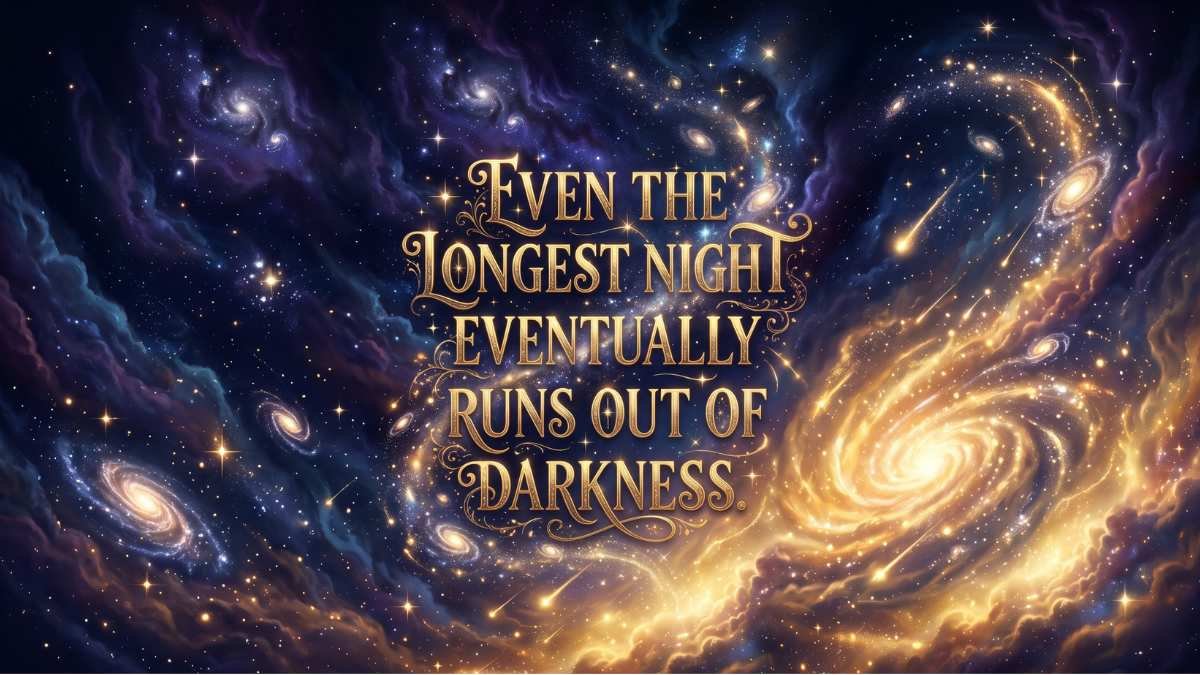
“Even the longest night eventually runs out of darkness.”
Take a slow breath and read that line one more time.
Maybe you are going through a hard time right now. Maybe you feel worried, sad, tired or alone. Maybe the waiting has been so long that you have started to wonder if morning will ever come.
This article is written just for you, in simple words, so that anyone, even a child, can understand it. By the end, I hope you will feel a little more hopeful and a little less alone.
What Does This Quote Really Mean?
Imagine the longest night of your life. Maybe you were a child lying awake, listening to the clock. Maybe it was a cold winter night when the sun went down early and seemed to take forever to come back.
What happened at the end of that night? The sun came up. It always does.
Darkness is not a house we live in. It is a hallway we walk through. And every hallway has a door at the end.
Hard times work the same way:
- Sadness may feel heavy, but it changes with time.
- Fear may feel huge, but it shrinks when we face it step by step.
- Loneliness may feel endless, but kind people and new days keep arriving.
- Pain may leave a mark, but it does not stay as loud as it is today.
The quote does not say the night is short. It does not say the night does not hurt. It says the night runs out. Even the longest one. That is a promise worth holding onto.
Wisdom That Is Thousands of Years Old
People have shared this hope for a very long time. The Bhagavad Gita (an ancient Indian scripture) and the Holy Bible (the sacred book of Christians) were written in different places and different times, yet both tell us that we have strength inside us, that we can find calm, and that we are never carried through the dark alone.
Below are three messages of hope. Under each one you will find a verse from the Gita and a matching verse from the Bible, with a simple meaning for both.
Message 1: You Have the Power to Lift Yourself Up
From the Bhagavad Gita (Chapter 6, Verse 5)
Lord Krishna teaches that a person should lift themselves up by the power of their own mind and never let themselves sink down. He explains that our mind can be our best friend or our worst enemy, depending on how we use it.
📖 Read it here: Bhagavad Gita, Chapter 6, Verse 5
What it means for you: Think about a little seed pushing up through heavy soil toward the light. Nobody pulls it out. It simply keeps reaching. On dark days your mind may whisper, “It’s hopeless.” You can gently answer, “Maybe not. Let me try one more small step.” That kind voice inside you is a friend worth keeping.
From the Holy Bible (Micah 7:8)
The prophet says: do not be glad over me, my enemy. Even though I have fallen, I will rise. Even though I sit in darkness, the Lord will be a light for me.
📖 Read it here: Micah 7:8 (KJV) on Bible Gateway
What it means for you: Notice how this verse talks about sitting in darkness, just like our quote. And it makes a promise anyway: you may fall, but you will rise, and a light will meet you in the dark.
Message 2: A Restless Mind Can Learn to Be Calm
From the Bhagavad Gita (Chapter 6, Verse 35)
Arjuna told Krishna that the mind is restless and very hard to control. Krishna agreed, and then gave good news: with steady practice and a calm, patient attitude, the mind can be trained and held steady.
📖 Read it here: Bhagavad Gita, Chapter 6, Verse 35
What it means for you: Have you ever tried to hold a wiggly puppy? At first it jumps and squirms everywhere. But with gentle, patient practice, it learns to sit. Your busy, worried mind is like that puppy. It is not bad. It just needs gentle practice, and it gets calmer every time you try.
From the Holy Bible (Isaiah 26:3)
The verse says that God will keep a person in perfect peace when their mind rests on Him, because they trust Him.
📖 Read it here: Isaiah 26:3 (KJV) on Bible Gateway
What it means for you: When storms rage on the sea, the deep water underneath stays still. Peace is not about having no problems. It is about giving your mind a quiet place to rest while the problems are still around. Prayer, trust and calm thoughts can be that quiet place.
Message 3: You Do Not Have to Carry Everything Alone
From the Bhagavad Gita (Chapter 9, Verse 22)
Krishna promises that for those who think of Him with steady love and trust, He brings what they are missing and protects what they already have.
📖 Read it here: Bhagavad Gita, Chapter 9, Verse 22
What it means for you: When you are tired and low on strength, it is hard to believe help will come. This verse says that when we trust and keep our hearts turned toward the good, we are looked after. It is like a lighthouse keeper who keeps the lamp burning so travelers at sea are never completely lost.
From the Holy Bible (Matthew 11:28)
Jesus says: come to me, all you who are tired and carrying heavy loads, and I will give you rest.
📖 Read it here: Matthew 11:28 (KJV) on Bible Gateway
What it means for you: Imagine a heavy school bag with too many books in it. Someone kind offers to carry it for a while. Rest is not weakness. It is part of the journey, and you are allowed to ask for it.
When Will This Quote Help You the Most?
Keep this quote in your pocket for moments like these:
- After a loss. When someone, something or some dream is gone, and every day feels slow and foggy.
- When worry will not stop. Your mind keeps racing with “what if” thoughts, especially at night.
- When you feel stuck. You keep trying, but nothing seems to move.
- During lonely seasons. When it seems like everyone else is happy and you are on the outside.
- When you are worn out. You have been strong for so long that you just want to rest.
- For children and teens. Tests, friendship trouble, moving schools, or big changes can feel like a never-ending night. This quote says: big feelings pass.
When you feel the dark closing in, say it out loud: “Even the longest night eventually runs out of darkness.” Then try one of the three exercises below.
3 New Mind-Body Exercises for Dark Nights
Your mind and body are best friends. When the mind is upset, the body gets tight. When the body relaxes, the mind often follows. These three exercises are simple enough for a child. Each one works in a different way: through your muscles, your touch and your imagination.
Exercise 1: Squeeze the Lemon (for a tight, tense body)
- Sit or lie down comfortably.
- Imagine you are holding a big lemon in each hand.
- Squeeze your fists tight, as if you are squeezing out every drop of juice. Hold for 5 seconds.
- Now let go completely. Let your hands go floppy and feel the difference.
- Do the same with your shoulders (lift them up to your ears, then drop them), your face (scrunch it up, then relax), and your feet (curl your toes, then release).
- Finish with one slow breath.
Why it helps: When we are worried, we tighten our muscles without noticing. Squeezing and then letting go teaches the body what “relaxed” feels like. Once the body feels safe, the mind gets the message too.
Exercise 2: The Butterfly Hug (for feeling alone or sad)
- Cross your arms over your chest, with your hands resting near your collarbones or shoulders. Your hands make the shape of butterfly wings.
- Slowly tap one hand, then the other, back and forth, like a gentle heartbeat.
- Keep tapping slowly while you breathe in and out.
- Say softly to yourself: “I am here. I am safe right now. The night will end.”
- Continue for 1 to 2 minutes, or as long as it feels good.
Why it helps: Gentle touch and slow, steady rhythm tell your nervous system it is okay to calm down, much like being rocked when you were a baby. It is a hug you can give yourself anywhere, any time, with nobody watching.
Exercise 3: Sunrise in Your Mind (for a hopeless or heavy heart)
- Close your eyes and settle into a comfortable position.
- Picture yourself in a quiet place, a hill, a beach or a garden. It is still dark, and the air is cool and calm.
- Imagine a thin line of soft gold light appearing far away.
- Watch the light slowly grow. See the sky turn from deep blue to purple to pink to bright gold.
- Feel the warmth of the sunshine on your face. Notice how your chest feels lighter with each moment.
- Stay there for a minute or two. When you are ready, open your eyes and take one slow breath.
Why it helps: Your brain responds to vivid pictures almost as it does to real life. Imagining the sunrise gives your mind a calm and hopeful experience to hold on to, and it practices the idea that morning is on its way.
Learn more about building positive habits in our recent internal guide.
External Resources on Giving Your Mind New Possibilities
If you’d like to explore this topic further, these resources are helpful starting points:
- Explore full Bhagavad Gita translations at Holy Bhagavad Gita
- Read more Bible verses on hope and new beginnings at BibleGateway
- Learn how to turn negative thoughts into hopeful ones with Mayo Clinic’s guide to positive thinking
- Read more about managing emotions and finding balance at HelpGuide’s guide to improving emotional intelligence
A Gentle Reminder
These words and exercises are caring tools, but they do not replace real help. If your sadness feels too heavy, lasts a long time, or makes you feel unsafe, please talk to a doctor, a counselor or someone you trust.
Final Thoughts: The Sun Is Already on Its Way
Here is what we learned today:
- Every night, even the longest one, comes to an end.
- You can lift yourself up one gentle thought at a time (Gita 6.5, Micah 7:8).
- A restless mind can be trained to find calm (Gita 6.35, Isaiah 26:3).
- You do not have to carry everything alone (Gita 9.22, Matthew 11:28).
- Squeezing, hugging and imagining are simple tools to make the night gentler.
You may not see the sunrise yet. That is okay. Morning does not arrive all at once. First the dark thins, then a soft grey appears, then a thin line of gold. Perhaps you are already in that grey stretch, closer to the light than you think.
So rest when you need to, be kind to yourself, and take one small step. Even the longest night eventually runs out of darkness, and your morning is on its way.