
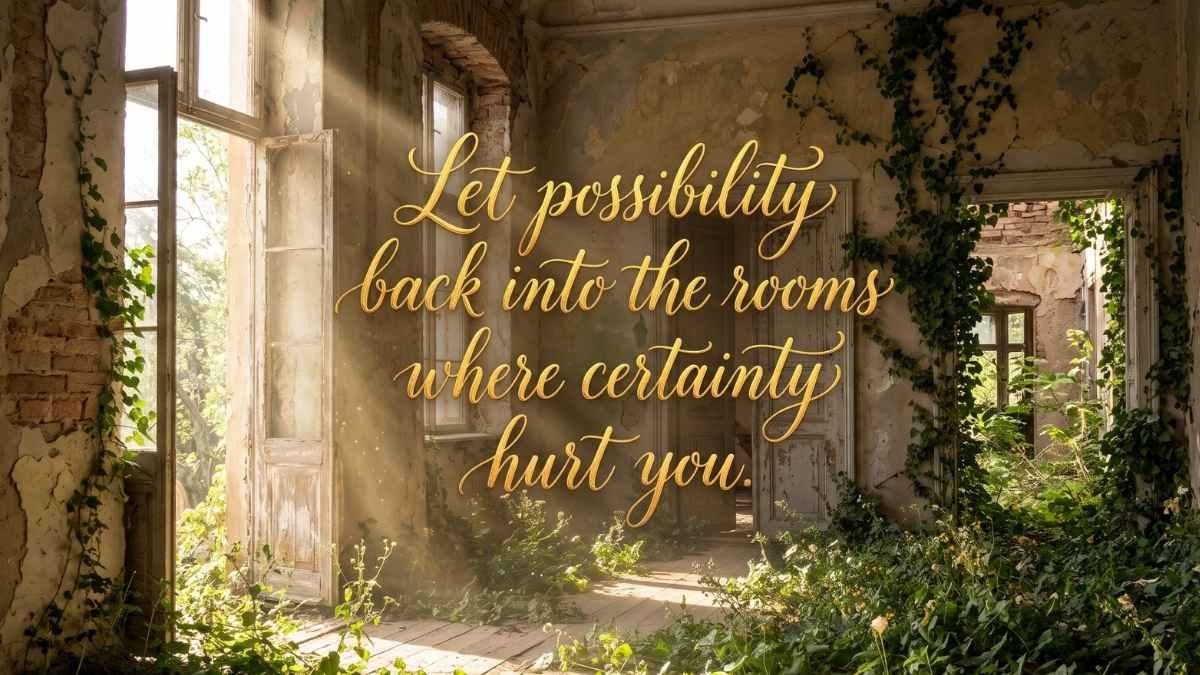
Have you ever been told something was “for sure,” and then it broke your heart? Maybe a job ended. Maybe a person left. Maybe a doctor, a teacher, or your own mind said, “This will never get better.” After a hurt like that, it is normal to close the door and stay inside the small room of “I know how this ends.”
Today we will learn how to let possibility back into the rooms where certainty hurt you. This line is a gentle reminder that one painful ending does not get to write the whole story. We will keep this simple, so even a child can follow along. We will also look at three wise verses from the Bhagavad Gita, three matching verses from the Holy Bible, and three easy mind-and-body exercises that can bring hope back.
What Does “Let Possibility Back In” Really Mean?
Think of your life like a big house with many rooms. One room is called “Work.” Another is called “Love.” Another is called “Health.” Another is called “My Dreams.”
Sometimes something hurts us in one of those rooms. Maybe we hoped for a good result, but the answer was a loud, hard “No.” After that, our mind does something clever but not very kind. It tells us, “Now you know for sure. It will always be like this. Do not try again.”
That is certainty. It sounds strong and safe. But when certainty is built from pain, it works like a locked door. The door keeps hurt out, but it also keeps out fresh air, sunlight, and good surprises.
Possibility is simply opening the window a little. It says, “Maybe. What if things can change? What if there is more to the story?” You do not have to believe everything will be perfect. You only have to leave a small crack of light.
Why Certainty Can Hurt So Much
Here are some common sentences that feel like facts but are really just fear wearing a costume:
- “I always fail.”
- “Nobody will ever understand me.”
- “It is too late for me.”
- “Good things do not happen to people like me.”
When we say these words again and again, our body listens. Our shoulders tighten. Our stomach feels heavy. Our breathing gets short. The mind and body are best friends, and they copy each other. A scared thought can create a tense body, and a tense body can make the thought feel even more true.
The good news is that this works in the other direction too. A softer thought can relax the body, and a relaxed body can make hope easier to feel. That is what the exercises later in this article are for.
Wisdom From the Bhagavad Gita and the Holy Bible
People all over the world have faced pain and found hope again. Two of the most loved books of wisdom, the Bhagavad Gita and the Holy Bible, give us guidance. Below are three teachings from each. Each pair has a similar message, even though the words are different. The meanings are explained in simple language, and each verse links to a trusted source so you can read the full chapter yourself.
1. “This Pain Will Pass”
Bhagavad Gita, Chapter 2, Verse 14 Read it here: Bhagavad Gita 2.14
Meaning in simple words: Krishna teaches that happy feelings and sad feelings are like summer and winter. They come, and they go. They do not stay forever. So we should learn to be patient and keep going, because no feeling is permanent.
Holy Bible, Psalm 30:5 Read it here: Psalm 30 on Bible Gateway
Meaning in simple words: The psalm says that “weeping may stay for the night, but rejoicing comes in the morning.” Sad nights are real, but they do not last. Morning always arrives.
What it means for you: If certainty told you, “This hurt is forever,” these two verses answer, “No. Even winter ends.” That is possibility knocking on the door.
2. “Your Mind Can Be Your Friend”
Bhagavad Gita, Chapter 6, Verse 5 Read it here: Bhagavad Gita 6.5
Meaning in simple words: Krishna says we should lift ourselves up with our own mind and never pull ourselves down. Our mind can be our best friend or our worst enemy, depending on how we talk to ourselves.
Holy Bible, Romans 12:2 Read it here: Romans 12 on Bible Gateway
Meaning in simple words: The Apostle Paul teaches that we can be changed by renewing our mind. In other words, when we choose new, healthier thoughts, our life can begin to change too.
What it means for you: You are not stuck with the old, hurtful thoughts. You can learn to speak to yourself the way a kind friend would speak to you.
3. “Do Not Be Afraid”
Bhagavad Gita, Chapter 18, Verse 66 Read it here: Bhagavad Gita 18.66
Meaning in simple words: Krishna invites us to let go of our heavy worries and trust in a higher power. He tells us not to grieve, because we are not alone and we will be cared for.
Holy Bible, Isaiah 41:10 Read it here: Isaiah 41 on Bible Gateway
Meaning in simple words: God tells us not to fear, because He is with us. He promises to strengthen and help us, and to hold us up when we feel weak.
What it means for you: You do not have to open the door to hope all by yourself. Whether you pray, meditate, or simply sit quietly, there is strength beyond your own that is ready to walk in with you.
When Will This Quote Be Most Helpful?
The line “let possibility back into the rooms where certainty hurt you” is especially helpful when:
- You were rejected. A job, a school, a friendship, or a love said no, and now you believe you will always be turned away.
- You received hard news. A bad report card, a scary health result, or a loss made your mind say, “That is the end.”
- You failed at something important and now you are afraid to try again.
- You are grieving. You lost someone or something dear, and it feels like happiness is gone forever.
- You feel stuck in old stories, such as “I am not good enough,” that you have repeated for years.
- You are afraid to hope because hoping once ended in disappointment.
If any of these sound like you, please know that it makes sense to feel this way. Hurt is real. The goal is not to pretend that nothing happened. The goal is to make sure that one painful chapter does not become the whole book.
Three Simple Mind-and-Body Exercises to Bring Hope Back
These exercises are called psychosomatic exercises. That is a big word with a small meaning: “psycho” means mind, and “soma” means body. These practices use the body to calm the mind and the mind to relax the body. Each one is different, and each takes only a few minutes. You can do them sitting on a chair, on your bed, or on the floor.
Exercise 1: The Open Door Breath (Calming Your Body)
This exercise tells your body, “You are safe right now.”
- Sit comfortably. Place one hand on your chest and one hand on your belly.
- Breathe in slowly through your nose for a count of 4. Imagine a door slowly opening in front of you.
- Hold your breath gently for a count of 2.
- Breathe out slowly through your mouth for a count of 6, as if you are blowing out a candle very softly.
- As you breathe out, quietly say to yourself, “Maybe there is room for something new.”
- Repeat this 8 times.
Why it helps: A longer breath out tells your body to slow down. When the body calms down, the mind stops shouting “never” and “always.”
Exercise 2: The Fist and Release (Letting Go of “I Know How This Ends”)
This exercise helps you feel what it is like to hold on tightly, and then to let go.
- Make both hands into tight fists. Squeeze as if you are holding on to the old, painful story. Hold for 5 seconds.
- Notice how your arms feel. They are probably tight and tired.
- Now open your hands slowly and let your fingers spread wide. Feel the warmth and tingling.
- Say softly, “I do not have to be sure. I can leave the door open.”
- Do the same with your shoulders: lift them up to your ears for 5 seconds, then let them drop.
- Do the same with your face: scrunch it up for 5 seconds, then relax it.
Why it helps: Many of us carry old hurts in tight muscles without knowing it. When the body learns to release, the mind often learns that releasing is safe.
Exercise 3: The Window Walk (Turning on Possibility)
This exercise gently moves your mind from “nothing can change” to “something might.”
- Stand near a window, or step outside if you can.
- Look around and find 3 things you can see, such as a tree, a cloud, or a bird. Say them out loud.
- Notice 2 things you can hear, such as wind, voices, or footsteps.
- Notice 1 thing you can feel, such as your feet on the ground or sunlight on your skin.
- Now ask yourself one small question: “What is one good thing that could possibly happen this week?” It can be tiny, like a kind message, a warm meal, or a good laugh.
- Write it down or say it out loud. Then take one small step toward it.
Why it helps: Looking at the real world pulls your mind out of worry and into the present moment. Then one small question reminds your brain that the future is not yet written.
A Gentle Reminder Before You Go
You do not have to throw the doors wide open today. Start with a small crack. One deep breath. One kind thought. One small step. That is enough.
Remember these three truths:
- Pain is real, but it is not permanent. Winter turns into spring.
- Your mind can become your friend. You can choose gentler words.
- You are not alone. Strength is available when you ask for it.
Learn more about building positive habits in our recent internal guide.
External Resources on Giving Your Mind New Possibilities
If you’d like to explore this topic further, these resources are helpful starting points:
- Explore full Bhagavad Gita translations at Holy Bhagavad Gita
- Read more Bible verses on hope and new beginnings at BibleGateway
- Learn how to turn negative thoughts into hopeful ones with Mayo Clinic’s guide to positive thinking
- Read more about managing emotions and finding balance at HelpGuide’s guide to improving emotional intelligence
Frequently Asked Questions
What does “let possibility back into the rooms where certainty hurt you” mean? It means allowing yourself to believe that things can change, even in the areas of life where you were once badly hurt by a harsh or final-sounding “no.”
Is it okay to feel afraid of hoping again? Yes. After disappointment, hope can feel risky. Start small and be patient with yourself.
Can these exercises replace therapy or medical care? No. They are gentle helpers for everyday stress, but they do not replace professional support when you need it.
How often should I practice them? Even once a day for a few minutes is helpful. Many people like to practice in the morning or before sleep.
Final Thoughts
A closed door may have protected you once, but you were never meant to live in a locked room forever. The Bhagavad Gita and the Holy Bible both remind us that pain passes, that our minds can be renewed, and that we are not alone. So take a deep breath, open the window just a little, and let possibility back into the rooms where certainty hurt you. A new morning is already on its way.
Please remember: these exercises are for everyday calm and encouragement. If you feel overwhelmed for a long time, please talk with a doctor, counsellor or someone you trust. Asking for help is one of the wisest things a person can do.