
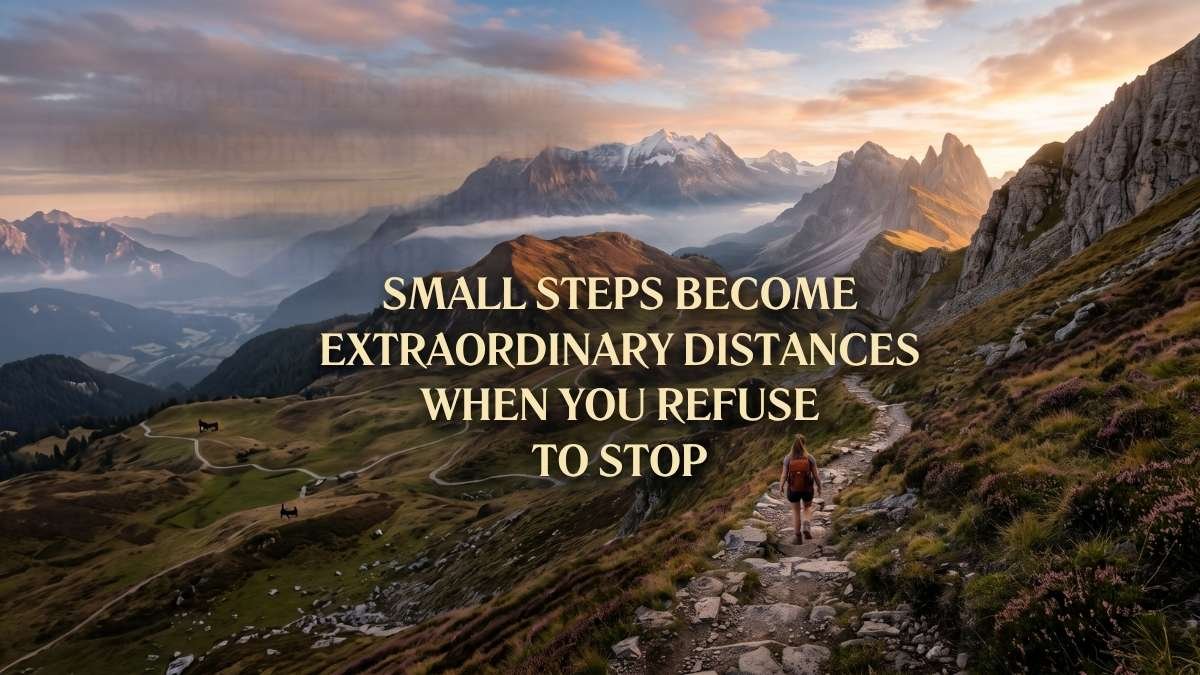
Have you ever looked at a huge mountain and thought, “I could never climb that”? Maybe the mountain is a goal, a bad time in your life, or a dream that feels too far away. Many of us feel this way at some point.
Here is a gentle truth that can lift your heart: small steps become extraordinary distances when you refuse to stop. You do not need to leap. You do not need to be fast. You only need to keep moving, one small step after another.
This article is written simply, so that a child can follow it, and warmly, so that anyone who feels tired or discouraged can find hope. Along the way we will look at three wise sayings from the Bhagavad Gita and three matching verses from the Holy Bible. At the end you will learn three easy mind-body exercises you can try today.
Why Do Small Steps Matter So Much?
Think about a snail. It is tiny and slow. Yet a snail can cross a whole garden, because it never stops moving.
Or think about reading a big book. Nobody reads a thousand pages at once. You read one page, then another. Soon the book is finished.
Small steps work because of three simple reasons:
- They are easy to start. A big task feels scary. A tiny step feels safe.
- They build confidence. Each little step you finish tells your brain, “I can do this.”
- They add up. One step is small. A thousand steps is a journey. A million steps can cross a country.
When you feel hopeless, your mind says, “It is too far.” Hope answers, “Just take the next step.”
The Secret Ingredient: Refusing to Stop
Notice that the quote does not say “small steps become extraordinary distances.” It says they do so when you refuse to stop.
Refusing to stop does not mean never resting. Resting is wise. Even a traveler sleeps at night. Refusing to stop means you do not give up on your goal. You may go slowly. You may stumble. You may sit down for a while. But you get back up.
The old wisdom of India and the old wisdom of the Bible both teach this same lesson, in different words. Let us listen to them.
Three Bhagavad Gita Quotes and Their Bible Partners
The Bhagavad Gita is an ancient Indian book of wisdom. It is a conversation between a prince named Arjuna, who feels lost and afraid, and his guide, Krishna, who helps him find courage. Many people around the world, of many faiths, find comfort in it.
1. A Little Effort Is Never Wasted
Bhagavad Gita 2:40: Meaning in simple words: On the path of doing good, no effort is ever wasted, and nothing is ever lost. Even a small bit of this effort protects you from great fear.
Imagine you planted a tiny seed and forgot about it for a while. The seed did not disappear. It was growing underground, out of sight. The Gita says your small efforts are like that seed. Even on days when you cannot see any progress, your effort is not wasted.
Matching Bible verse: Zechariah 4:10: “For who hath despised the day of small things?” (KJV)
Meaning in simple words: Do not look down on small beginnings. God sees them and values them. A tiny start is still a real start.
Both books say the same kind thing: small is not the same as useless. Your little step today matters.
2. You Can Lift Yourself Up
Bhagavad Gita 6:5: Meaning in simple words: Lift yourself up by your own mind, and do not let yourself sink down. Your mind can be your best friend, or it can act like your enemy.
Have you noticed that when you feel down, your thoughts can become unkind? “I am too slow. I will never finish.” The Gita invites you to become your own friend. Talk to yourself the way you would talk to someone you love: “You are doing your best. Let us take one more step.”
Matching Bible verse: Isaiah 40:31: “But they that wait upon the LORD shall renew their strength; they shall mount up with wings as eagles; they shall run, and not be weary; and they shall walk, and not faint.” (KJV)
Meaning in simple words: When you trust in God and keep hoping, new strength comes to you. You may fly like an eagle, run without tiredness, or simply walk without fainting. Notice that even walking is celebrated. A slow walk is still a victory.
Both teachings say that strength can be renewed. You are not stuck being weak forever.
3. Practice Calms a Restless Mind
Bhagavad Gita 6:35: Meaning in simple words: Krishna admits that the mind is restless and hard to control, but he says it can be trained through steady practice and by letting go of worries.
This verse is very honest. It does not pretend that life is easy. Your mind will jump around, worry, and want to quit. But with gentle, steady practice, a little each day, it grows calmer and stronger. This is exactly how small steps work.
Matching Bible verse: Galatians 6:9: “And let us not be weary in well doing: for in due season we shall reap, if we faint not.” (KJV)
Meaning in simple words: Do not get tired of doing good things. If you keep going and do not give up, a good harvest will come at the right time.
Think of a farmer. Seeds do not turn into food overnight. The farmer waters, waits and trusts. The Bible and the Gita agree: patient, steady effort brings its harvest.
When Will This Quote Help You Most?
The words “small steps become extraordinary distances when you refuse to stop” are like a lantern. They are especially helpful in these situations:
- When a goal feels too big. You want to start a business, finish school, write a book or learn a new skill, and you do not know where to begin.
- When you are recovering. After an illness, a loss, a job change or a hard season, even getting out of bed can feel heavy. Small steps are enough.
- When you have failed and want to quit. A setback is not the end. It is a bump in the road.
- When you feel left behind. You see others racing ahead and feel slow. Remember, the snail and the sprinter both cross the garden eventually.
- When you feel hopeless. If everything looks dark, you do not need to see the whole road. You only need enough light for the next step.
Three Simple Mind-Body Exercises for Hope
Our minds and bodies talk to each other all the time. When your body feels calm, your mind finds it easier to feel hopeful. Here are three easy exercises, each different from the others. A child can do them too. They are gentle and safe for most people, but stop if anything feels uncomfortable.
Exercise 1: Finger-Trace Breathing (about 2 minutes)
This exercise calms a worried mind.
- Sit comfortably. Hold one hand out in front of you with your fingers spread wide.
- Use the pointer finger of your other hand to trace up the outside of your thumb. Breathe in slowly through your nose as you go up.
- Breathe out slowly through your mouth as you trace down the other side of your thumb.
- Keep going: up and down each finger, until you have traced all five.
Why it helps: Slow breathing tells your body, “You are safe.” The tracing gives your busy mind one small job to do, so worries get quieter. Each finger is a small step, which makes it a lovely reminder of today’s message.
Exercise 2: Ten Slow Steps (about 3 minutes)
This exercise turns the quote into something you can feel in your body.
- Stand up in a quiet space, indoors or outdoors.
- Walk very slowly for ten steps. Feel your heel touch the ground, then your toes.
- With each step, quietly say one word: “Small… step… small… step…” or whatever feels kind to you.
- At step ten, stop, take one deep breath, and say, “I am moving forward.”
- Turn around and do ten more if you like.
Why it helps: Paying attention to your feet brings your mind out of “what if” worries and into the present moment. You prove to yourself that you can move, and moving, even slowly, builds hope.
Exercise 3: Squeeze, Release and Smile (about 3 minutes)
This exercise melts away stress stored in your body.
- Sit or lie down comfortably. Make two tight fists and squeeze for five seconds, as if you were squeezing a lemon.
- Let go all at once. Notice the warm, loose feeling in your hands.
- Next, gently lift your shoulders up to your ears for five seconds, then let them drop.
- Finally, scrunch your face tight for a moment, release it, and let a soft smile appear, even a tiny one.
- Place a hand on your heart and say, “I am doing my best, and that is enough.”
Why it helps: When we worry, our muscles tighten without our noticing. Tensing and then releasing them teaches your body what relaxing feels like. A relaxed body helps a hopeful mind.
A Little Story to Remember
Imagine a girl named Maya who wanted to run a school race but could barely jog to the corner. She felt silly. So she made a tiny promise: “I will run to the next mailbox.” The next day, “I will run to the next tree.” Some days it rained, and some days she walked instead. But she never said, “I quit.”
A few months later, Maya crossed the finish line of her first race. Nobody saw the hundreds of tiny steps behind it, but Maya knew. She understood that small steps become extraordinary distances when you refuse to stop.
Your Next Small Step
You do not have to change your whole life today. Just choose one small thing:
- Write down one tiny goal for tomorrow.
- Try one of the three exercises above.
- Read one of the verses again and let it sink in.
- Tell one kind person that you are trying.
That is enough. The Gita says no effort is wasted. The Bible says do not despise small beginnings. Together they whisper the same encouragement across thousands of years: keep going, because you are not walking alone.
Learn more about building positive habits in our recent internal guide.
Resources and Further Reading
Want to read these verses for yourself? These pages are free and easy to follow:
- Bhagavad Gita 2:40, Bhagavad Gita As It Is, Chapter 2, Text 40, with a word-by-word meaning and a short explanation.
- Bhagavad Gita 6:5, Chapter 6, Text 5 on Holy Bhagavad Gita, with a clear translation and commentary.
- Bhagavad Gita 6:35, Chapter 6, Verse 35 on Enjoy Learning Sanskrit, with the Sanskrit and an English translation.
- Zechariah 4:10, Bible Gateway, many translations side by side.
- Isaiah 40:31, Bible Gateway, many translations side by side.
- Galatians 6:9, Bible Gateway, many translations side by side.
Final Thoughts: Hope Is a Direction, Not a Speed
It does not matter how slowly you move. What matters is that you keep facing forward. Your small steps today are building tomorrow’s road.
So if you feel tired, rest, and then take one more step. Small steps become extraordinary distances, and one day, when you look back, you will be amazed at how far you have come.