
There are moments in life when you have real power over someone else’s feelings — a sharp word that could wound, or a gentle word that could comfort. In that exact moment, you get to decide what kind of person you want to be. Here is a gentle truth worth remembering:
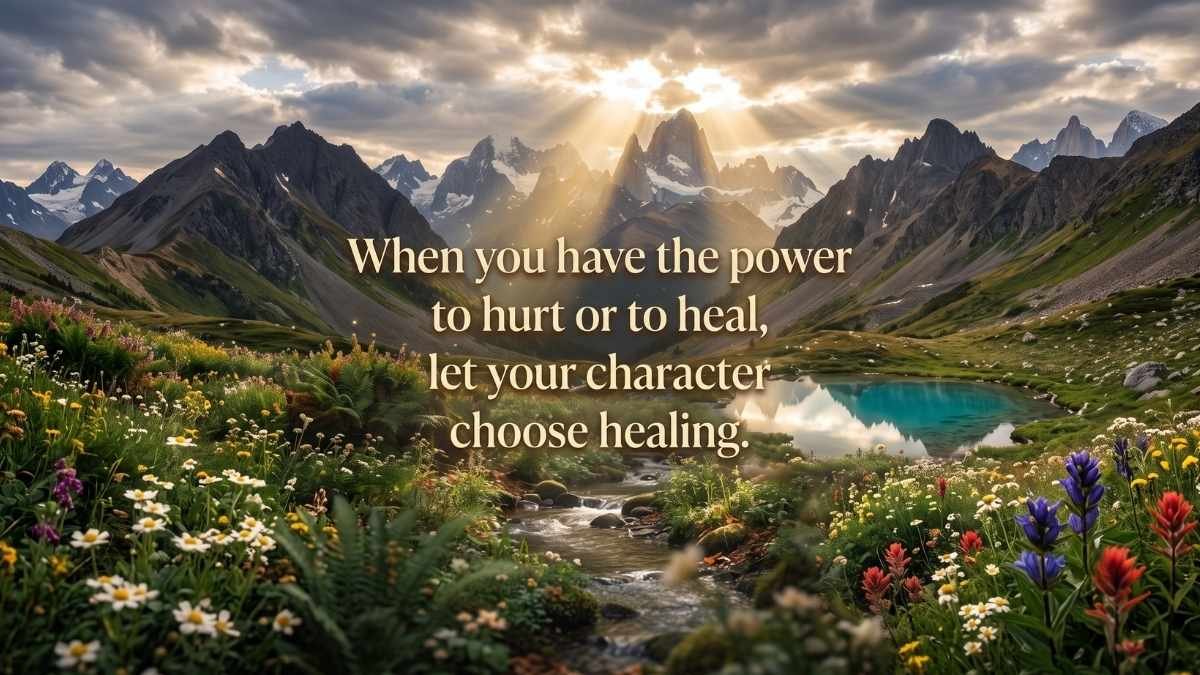
When you have the power to hurt or to heal, let your character choose healing.
This isn’t about being weak or letting people walk over you. It’s about recognizing that real strength shows up most clearly in how gently we treat others when we could have chosen otherwise. Let’s understand this in a simple way — so simple that even a child could read it and feel a little kinder afterward.
What This Quote Really Means
Imagine holding a small bird in your hands. You could easily hurt it without even trying hard — just a little too much pressure would be enough. But you could also hold it gently, safely, letting it feel protected instead of afraid. The power is the same in both hands. The only difference is the choice you make with it.
People are often like that little bird in our hands, especially when they’re upset, tired, or already hurting. A sharp reply, a cold silence, or an unkind comment can hurt them quickly and easily. But so can a soft word, a patient pause, or a small act of understanding help heal them just as easily.
Choosing healing doesn’t mean pretending everything is fine, or letting go of boundaries. It means, in the small moments where you truly have a choice, leaning gently toward kindness instead of harm — even when hurting would have been easier or quicker.
This choice usually isn’t dramatic. Most of the time, choosing healing looks quiet and small — a softer tone of voice, a pause before a sharp reply, a decision to listen instead of lecture. But these small choices add up, slowly shaping the kind of person others feel safe around.
Ancient Wisdom on Choosing Healing
This idea isn’t new. The Bhagavad Gita and the Holy Bible both speak beautifully about choosing gentleness and compassion over harm — about learning to choose healing, again and again, until it becomes second nature. Here are three teachings, paired together.
Quote 1 — The Qualities of a Gentle Heart
Bhagavad Gita, Chapter 16, Verses 2-3: “Non-violence, truthfulness, freedom from anger, compassion for all living beings, gentleness, and forgiveness are among the qualities of one born with a divine nature.”
Simple Meaning: This verse offers a simple checklist for the kind of heart worth building — one that avoids causing harm and chooses gentleness instead. Choosing healing over hurting is not a rare gift reserved for a few; it’s a quality anyone can practice and grow.
Equivalent Bible Quote — Galatians 5:22-23: “The fruit of the Spirit is love, joy, peace, longsuffering, gentleness, goodness, faith, meekness, temperance.”
Simple Meaning: Both teachings offer nearly identical lists of gentle qualities. They remind us that a truly strong character is measured by patience and kindness, not by how sharply we can hurt someone when given the chance.
Quote 2 — A Friend to All, Free From Ill Will
Bhagavad Gita, Chapter 12, Verse 13: “One who is free from ill will toward all beings, who is friendly and compassionate, free from possessiveness and ego, is very dear.”
Simple Meaning: This verse describes someone who chooses warmth over resentment, even toward people who might not deserve it. Choosing healing often means offering kindness before someone has earned it, simply because kindness is who we’ve decided to be.
Equivalent Bible Quote — Ephesians 4:32: “Be ye kind one to another, tenderhearted, forgiving one another, even as God for Christ’s sake hath forgiven you.”
Simple Meaning: Both scriptures ask the same gentle thing of us — to be kind and forgiving, not because it’s always easy, but because it reflects the best of who we can be.
Quote 3 — Taming the Urge to Harm
Bhagavad Gita, Chapter 3, Verse 37: “It is desire and anger, born from passion, that push a person toward harmful action, and these forces are among the greatest enemies in this world.”
Simple Meaning: This verse honestly names what usually leads us to hurt others — anger and unchecked desire. Recognizing this is the first step toward choosing a calmer, healing response instead of reacting from that anger.
Equivalent Bible Quote — James 1:19-20: “Let every man be swift to hear, slow to speak, slow to wrath: for the wrath of man worketh not the righteousness of God.”
Simple Meaning: Both teachings gently warn us that quick anger rarely leads anywhere good. Choosing healing often begins with simply slowing down before we speak or act.
A Short Story About Choosing Healing
Aditi’s younger brother accidentally broke a gift she deeply treasured. Her first instinct was to shout — the words were already forming in her mind, sharp and ready. She had every “right” to be upset, and she had the power, in that moment, to make her brother feel truly terrible, or to choose healing instead.
Instead, she paused, took a breath, and knelt down to his level. She said quietly, “I’m sad about this, but I know it was an accident. Thank you for telling me the truth instead of hiding it.” Her brother, who had been bracing for anger, burst into relieved tears and hugged her tightly. Years later, he still remembers that moment as the reason he always felt safe telling her the truth, even when he made mistakes. Aditi had the power to hurt him deeply that day — and she chose healing instead.
When This Quote Proves Most Helpful
This quote brings guidance in moments like these:
- When someone has hurt or disappointed you, and you’re deciding how to respond.
- When you’re a parent, teacher, or leader with real influence over someone smaller or more vulnerable than you.
- When you’re angry and tempted to say something you know will sting.
- When you’re in a position to gossip, criticize, or stay silent and kind instead.
- When you’re recovering from your own pain and deciding whether to pass it on or transform it. (If old wounds are shaping how you react to others, our guide on gently healing past hurt may help alongside this article.)
- When forgiving someone feels hard, but staying bitter feels heavier.
In each of these moments, remembering that you truly have the power to choose healing can turn a painful exchange into a moment of unexpected grace, for both of you.
Three Psychosomatic Exercises For Choosing Healing
“Psychosomatic” simply means connecting mind and body together. These three simple exercises use breath, touch, and gentle timing to help your body pause long enough for you to choose healing instead of reacting in hurt. No equipment needed — a child can try these too.
Exercise 1: The Ten-Second Pause Breath. The moment you feel the urge to say something sharp, pause. Breathe in slowly while silently counting to five. Breathe out slowly while counting to five again. This ten-second pause gives your body time to calm its first reaction, making room for a gentler, wiser response.
Exercise 2: The Anger Unclench. Clench both fists tightly for 5 seconds, noticing the tension of frustration or hurt building inside them. Then slowly, gently, uncurl your fingers one at a time, as you exhale fully. This physically mirrors letting go of the urge to hurt, replacing it with an open, softer response.
Exercise 3: The Healing Words Whisper. Before speaking in a tense moment, place one hand lightly near your heart or lips. Take one slow breath, and quietly whisper to yourself, “Let my words heal, not hurt.” This small ritual creates a brief, calming pause between feeling and speaking, helping kinder words rise to the surface first.
Learn more about building positive habits in our recent internal guide.
A Gentle Closing Thought
You will have many small moments in life where you hold real power over someone else’s heart — a reply, a reaction, a choice of words. In each of those moments, you get to decide who you want to be.
When you have the power to hurt or to heal, let your character choose healing. It may not always be the easiest choice, but it’s almost always the one that leaves both hearts a little lighter — and it’s a choice worth practicing, again and again, until choosing healing simply becomes who you are.