
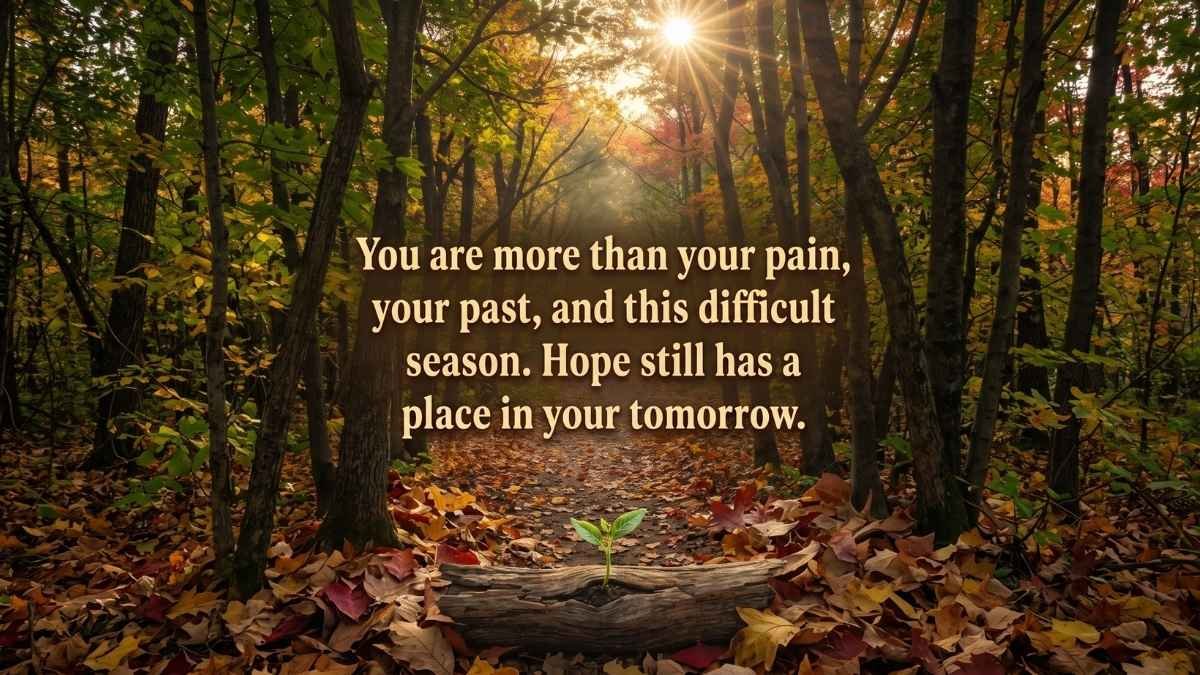
Some seasons of life feel heavy. Maybe you’re carrying something painful from your past, or today feels harder than you know how to explain. On days like these, it’s easy to believe that this pain is all you are. But here is a gentle truth worth holding close:
You are more than your pain, your past, and this difficult season. Hope for tomorrow still has a place waiting for you.
Pain is real, and it deserves to be honored, not ignored. But pain was never meant to define your whole story. Let’s understand this in a simple way — so simple that even a child could read it and feel a little lighter afterward.
What This Quote Really Means
Imagine a cloudy sky. On a cloudy day, it feels like the sun has disappeared completely. But the sun hasn’t gone anywhere — it’s simply hidden behind clouds for a while. The sky is still more than its clouds, even on the darkest afternoon.
You are like that sky. Your pain, your past, and this hard season are like clouds passing through — real, heavy, sometimes overwhelming. But they are not the whole sky. Underneath all of it, you are still there — whole, worthy, and capable of holding hope for tomorrow, even while today feels cloudy.
This doesn’t mean pretending the pain isn’t real. It means gently remembering that pain is something you are going through, not something you permanently are. A hard season has a beginning and an end, even when it doesn’t feel that way in the middle of it.
It also helps to remember that pain doesn’t need to be solved instantly to be survivable. You don’t need to have all the answers today. You simply need to keep breathing, keep taking small steps, and keep leaving a little room in your heart for hope for tomorrow, even on the days it feels far away.
Ancient Wisdom on Hope for Tomorrow
This idea isn’t new. The Bhagavad Gita and the Holy Bible both speak beautifully about carrying hope for tomorrow, even through pain and change. Here are three teachings, paired together.
Quote 1 — You Are More Than What Hurts
Bhagavad Gita, Chapter 2, Verse 20: “The soul is never born, and it never dies. It is not slain when the body is slain — it is eternal, unchanging, and beyond harm.”
Simple Meaning: This verse teaches that the deepest part of you cannot actually be destroyed by pain, loss, or a hard season. Your circumstances may hurt, but the core of who you are remains steady underneath it all, waiting for lighter days.
Equivalent Bible Quote — 2 Corinthians 4:17: “Our light affliction, which is but for a moment, worketh for us a far more exceeding and eternal weight of glory.”
Simple Meaning: Both teachings offer the same comfort — pain is temporary, but who you are underneath it is lasting. Hope for tomorrow grows stronger the moment we remember this difficult season is not the end of the story.
Quote 2 — Every Season Eventually Changes
Bhagavad Gita, Chapter 2, Verse 13: “Just as a person passes through childhood, youth, and old age within one body, the soul similarly passes through many changes; the wise are not shaken by this.”
Simple Meaning: Life naturally moves through different seasons, just like a person moves through different ages. A hard season, though painful, is simply one chapter — not the entire book.
Equivalent Bible Quote — Ecclesiastes 3:1: “To every thing there is a season, and a time to every purpose under the heaven.”
Simple Meaning: Both scriptures remind us that nothing stays the same forever, including pain. Hope for tomorrow rests gently on this truth — this season will shift, the way every season eventually does.
Quote 3 — A Promise That Doesn’t Run Out
Bhagavad Gita, Chapter 9, Verse 31: “Quickly the sincere soul becomes righteous and attains lasting peace. Declare it boldly — one who turns toward what is good is never truly lost.”
Simple Meaning: This verse is a bold, comforting promise — no matter how far a hard season has pulled you down, turning gently toward hope and goodness is never wasted effort. Peace is still within reach.
Equivalent Bible Quote — Jeremiah 29:11: “For I know the thoughts that I think toward you, saith the LORD, thoughts of peace, and not of evil, to give you an expected end.”
Simple Meaning: Both teachings promise the same quiet reassurance: your story is still being written with care, and hope for tomorrow has already been planned for you, even if you can’t see it yet.
A Short Story About Hope for Tomorrow
Priya went through a year that broke her heart in more ways than one — a job loss, followed by a difficult diagnosis in the family, followed by a friendship that quietly faded away. By the end of that year, she felt like her pain had become her whole identity. People asked how she was, and all she could talk about was how hard everything had been.
One evening, a mentor gently told her, “Priya, you carried a hard year. But you are not a hard year. You are still you underneath all of it.” That single sentence stayed with her. Slowly, she began separating what happened to her from who she was. The pain didn’t disappear overnight, but her hope for tomorrow slowly returned, one small day at a time — and eventually, she found herself smiling again, not because the pain was forgotten, but because she remembered she was always more than it.
When This Quote Proves Most Helpful
This quote brings comfort in moments like these:
- When you’re going through grief, heartbreak, or loss and feel defined by sadness. (If loss is part of your current season, our guide on gently processing grief may offer extra support alongside this article.)
- When a past mistake or failure keeps replaying in your mind.
- When a difficult diagnosis, illness, or health struggle feels overwhelming.
- When you feel like this hard season will never end.
- When you’ve stopped introducing yourself as anything other than “the person going through a hard time.”
- When you need a gentle reminder that tomorrow can still hold something good.
In each of these moments, remembering that you are more than your pain — and that hope for tomorrow is still waiting for you — can soften the weight of today, even just a little.
Three Psychosomatic Exercises For Hope
“Psychosomatic” simply means connecting mind and body together. These three simple exercises use breath, touch, and gentle movement to remind your body that you are safe, and that hope for tomorrow is still possible. No equipment needed — a child can try these too.
Exercise 1: The Hand on Heart Anchor. Place one hand gently over your heart. Take 3 slow breaths, feeling your chest rise and fall under your palm. Quietly say, “I am more than this moment.” This simple touch calms your nervous system and reminds your body that you are safe right now, in this breath.
Exercise 2: The Name and Release. Say quietly out loud what is hurting — for example, “I feel sad about…” Then take a deep breath in, and as you exhale, gently shake out both hands, like flicking water off your fingers. Repeat 3 times. Naming a feeling and physically releasing it afterward helps your body let go of tension the mind has been holding onto alone.
Exercise 3: The Tomorrow Stretch. Stand up, and slowly stretch both arms upward toward the sky, as if reaching toward tomorrow. Hold for 3 slow breaths, then gently lower your arms. As you do this, softly think, “Something good is still ahead.” This small upward movement physically shifts your posture and mood, helping your body feel lighter, even on a heavy day.
Learn more about building positive habits in our recent internal guide.
A Gentle Closing Thought
Whatever pain you’re carrying today, whatever season feels too heavy right now — please remember, you are not your pain. You are not your past. You are not even this difficult season. You are the one carrying all of it, and still standing.
Hope for tomorrow has not run out. It’s simply waiting, quietly, for you to turn toward it again.